

Hey there! As a supplier of PVC food grade hoses, I'm super excited to take you behind the scenes and show you how these essential products are made. PVC food grade hoses are used in a wide range of applications, from food and beverage processing to pharmaceutical manufacturing. They need to meet strict safety and quality standards to ensure that they're safe for use with consumable products. So, let's dive into the manufacturing process!
Step 1: Raw Material Selection
The first step in making a PVC food grade hose is choosing the right raw materials. We only use high - quality PVC resins that are specifically formulated to meet food safety regulations. These resins are free from harmful substances like lead, cadmium, and other heavy metals. They also have good chemical resistance, flexibility, and durability, which are crucial for food grade hoses.
In addition to the PVC resin, we may add other additives such as plasticizers, stabilizers, and lubricants. Plasticizers are used to make the PVC more flexible, while stabilizers help prevent the material from degrading over time. Lubricants make the manufacturing process smoother. All these additives are carefully selected to ensure they're also food - safe.
Step 2: Mixing the Ingredients
Once we've selected the raw materials, it's time to mix them together. We use a high - speed mixer to combine the PVC resin with the additives. This process is crucial as it ensures that the additives are evenly distributed throughout the PVC resin. The mixing time and temperature are carefully controlled to achieve the desired consistency.
During the mixing process, we also need to pay attention to the moisture content. Excess moisture can cause problems during the extrusion process, so we make sure the materials are dry before mixing. We use special drying equipment to remove any moisture from the raw materials.
Step 3: Extrusion
After the ingredients are well - mixed, the next step is extrusion. Extrusion is the process of forcing the PVC mixture through a die to create the shape of the hose. We use an extruder, which is a machine with a screw that pushes the PVC mixture through the die.
The die is a specially designed tool that determines the size and shape of the hose. For food grade hoses, we can create different diameters and wall thicknesses depending on the customer's requirements. The extruder heats the PVC mixture to a specific temperature to make it soft and malleable, allowing it to pass through the die easily.
As the hose comes out of the extruder, it's cooled down rapidly. This can be done using a water bath or air cooling. Cooling the hose quickly helps to set its shape and prevent it from deforming.
Step 4: Reinforcement (Optional)
Some food grade PVC hoses require reinforcement to increase their strength and pressure - resistance. There are different types of reinforcement methods. One common method is to use a braided or spiral reinforcement.

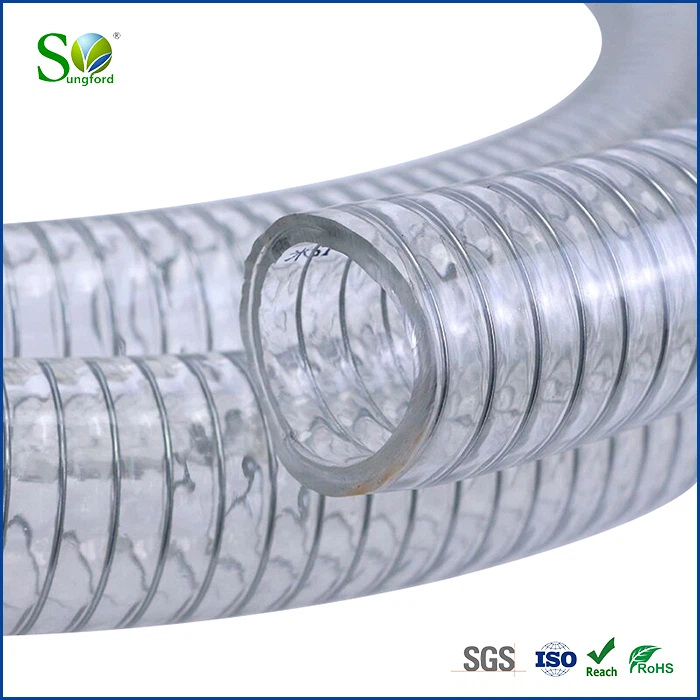
For braided reinforcement, we use high - strength fibers like polyester or nylon. These fibers are woven around the extruded PVC hose in a braided pattern. The braiding machine carefully controls the tension and pattern of the fibers to ensure even reinforcement.
Spiral reinforcement, on the other hand, involves wrapping a wire or a plastic strip around the hose in a spiral pattern. This provides additional strength and helps the hose maintain its shape under pressure. For example, our Food Grade Braided PVC Tubing uses a braided reinforcement for enhanced performance.
Step 5: Secondary Operations
After the hose is extruded and optionally reinforced, there are some secondary operations that may be required. One of these operations is cutting the hose to the desired length. We use precision cutting equipment to ensure accurate lengths.
We may also add fittings to the ends of the hose. Fittings are used to connect the hose to other components in a system. There are different types of fittings, such as couplings, elbows, and tees. These fittings are made from food - safe materials and are carefully installed to ensure a leak - proof connection.
Step 6: Quality Control
Quality control is an essential part of the manufacturing process. We have a strict quality control system in place to ensure that every PVC food grade hose meets the highest standards.
We conduct various tests on the hoses. For example, we test the hose for its chemical resistance by exposing it to different food substances. We also test its flexibility, tensile strength, and pressure - resistance. Any hoses that don't meet the quality standards are rejected.
We also check the appearance of the hoses. They should be free from any visible defects such as cracks, bubbles, or uneven surfaces. Our Food Grade Clear Vinyl Tubing is especially important to have a clear and smooth appearance for easy inspection.
Step 7: Packaging and Shipping
Once the hoses pass the quality control tests, they're ready for packaging. We use high - quality packaging materials to protect the hoses during transportation. The hoses are usually coiled and placed in plastic bags or cardboard boxes.
We label the packages with important information such as the hose size, length, and material specifications. Then, we ship the hoses to our customers all over the world.
Why Choose Our PVC Food Grade Hoses?
We take pride in our manufacturing process and the quality of our products. Our hoses are made with the highest - quality materials and strict quality control measures. Whether you need a simple Food Grade Clear Vinyl Tubing for a small - scale food operation or a heavy - duty Food Grade PVC Steel Wire Hose for a large - scale industrial application, we've got you covered.
If you're in the market for PVC food grade hoses, I encourage you to get in touch with us. We can provide you with detailed product information, samples, and competitive pricing. Our team of experts is always ready to answer your questions and help you find the right hose for your specific needs. Don't hesitate to reach out and start a conversation about your PVC food grade hose requirements.
References
- "Plastics Extrusion Technology" by Allan A. Griff.
- "Handbook of PVC Formulating" by Edward J. Wickson.