

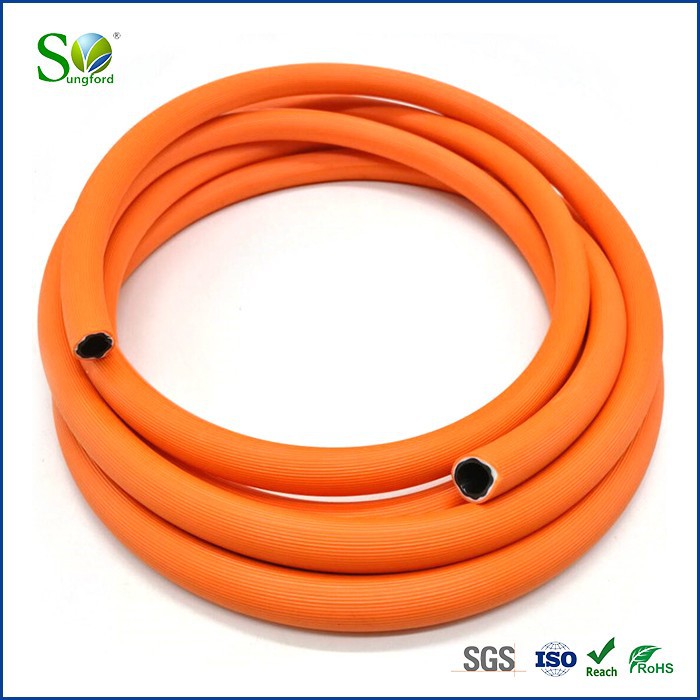
Gas Hose
Your Professional Gas Hose Supplier
Weifang Sungford Industrial Co.,Ltd was founded in 2005 and exported since 2008, quickly occupied the international market with stable and reliable quality and competitive price, and gained constant praise and good reputation.Sungford Plastic is one of the most professional PVC HOSE manufacturers and suppliers in China. As the scale continues to expand, we add new workshops and equipments recent years, Now the factory occupies an area of over 48,000 square meters, more than 70 production lines, the annual production capacity of 28,000 tons.


Why Choose Us
Product And Application
Our The products are widely used for the suction and delivery of fluid, gas, air, powder, particle, sediment in industry, engineering,construction, agriculture,mine, etc.
Certificate
With mature and advanced Korea production technology, strict quality control, Our corporation have passed ISO9001international quality conformity, REACH ,ROHS and SGS third party certification.
Professional team
We have professional and technical staff of 48 people, totally more than 300 employees, with new product development center and Special quality control department.
Advanced equipment
Korea one-step extrusion technology,advanced granulator, extruder, quality testing equipment, packing machine, etc.
Advantages of Gas Hose

Reliable Gas Supply: A gas hose serves as the vital connection between the gas source and your cooking equipment. It acts as a conduit for the fuel, providing a reliable and uninterrupted gas supply. Investing in a high-quality gas hose ensures a steady flow of gas to your appliances, enabling them to function optimally and deliver consistent heat for efficient cooking.
Safety Measures: Gas leaks can pose significant risks, such as fire hazards and the potential for explosions. A gas hose with proper safety features can greatly minimize these risks. Look for hoses that are constructed with durable materials, resistant to corrosion, and designed to withstand high pressure.
Flexibility and Convenience: Gas hoses offer the advantage of flexibility, allowing you to position your cooking equipment in various locations within your commercial kitchen. This flexibility enables you to optimize your workspace and adapt to changing needs. Additionally, gas hoses make it easier for BOH employees to connect and disconnect your appliances, simplifying maintenance tasks and equipment repositioning.
Compatibility: Different gas appliances may require specific types of gas hoses to ensure compatibility. It is essential to choose a gas hose that is suitable for your specific cooking equipment, considering factors such as the type of gas used (e.g., natural gas or propane) and the required flow rate.
Longevity and Durability: Gas hoses, like any other equipment, have a lifespan. Over time, wear and tear can compromise their integrity, potentially leading to leaks or other safety concerns. By purchasing a high-quality gas hose, you can ensure its longevity and durability. Regularly inspecting and replacing your gas hose as needed will help maintain the safety and reliability of your gas cooking equipment.
Specification
|
Item No. |
Inch |
I.D. (mm) |
O.D. (mm) |
W.P. (bar) |
B.P. (bar) |
|
GH065 |
1/4 |
6.5 |
12 |
20/40 |
60/120 |
|
GH080 |
5/16 |
8 |
14 |
20/40 |
60/120 |
|
GH100 |
3/8 |
10 |
16 |
20/40 |
60/120 |
|
GH130 |
1/2 |
13 |
20 |
20/40 |
60/120 |
|
GH160 |
5/8 |
16 |
24 |
20/40 |
60/120 |
|
GH190 |
3/4 |
19 |
28.5 |
20/40 |
60/120 |
|
GH250 |
1 |
25 |
34 |
20/30 |
60/90 |
|
GH320 |
1-1/4 |
32 |
44 |
15/30 |
45/90 |
|
GH380 |
1-1/2 |
38 |
50 |
15/30 |
45/90 |
|
GH500 |
2 |
50 |
63 |
15/30 |
15/90 |
Types of Gas Hose
PVC Pipe
PVC stands for Polyvinyl Chloride, the most popular type of plastic used in many applications. The making process of a PVC natural gas pipe is mainly the extrusion process. The raw material is melted and shaped into long, hollow tubes. People prefer using PVC natural gas hoses in residential or commercial gas supply lines.
Black Metal Natural Gas Line
Black metal pipes are typically made of steel and may also have a dark oxide layer coating. Although steel is already very corrosion-resistant, the oxide layer makes it more rust-resistant. The manufacturing process may differ based on the final use project. There are three processes: seamless, welding, and casting.
CSST Natural Gas Hose
The CSST natural gas hose is a common name among flexible and robust choices. CSST stands for Corrugated Stainless Steel Tubing. The unique corrugated structure is the main reason for these hoses’ flexibility. These hoses are widely used in residential, commercial, and industrial sites.
Copper Pipe
Copper pipes are ideal for indoor applications, and people prefer to use them in residential applications. The making process of these pipes may either be extrusion or casting.
Polyethylene Natural Gas Pipe
Polyethylene or PE natural gas hoses are made of thermoplastic polymers. They usually come from extrusion processes. PE gas pipes are highly flexible and resistant to environmental damage. They are widely used in underground, residential, and industrial settings.
Materials of Gas Hose
Metal corrugated hoses: Metal corrugated hoses have an inner core made of stainless steel or monel. These hoses are designed to prevent any permeation (discussed later), making them highly suitable for stationary gas applications.
Metal hoses: Rigid metal hoses are specifically designed for stationary applications. They have limited flexibility and bending capabilities. However, they are priced economically, making them a cost-effective choice.
Rubber hoses: Rubber hoses are flexible. They are widely available and affordable. However, rubber hoses may not be suitable for applications that require high levels of purity.
Ethylene tetrafluoroethylene (ETFE) hoses: ETFE hoses are flexible, durable, and cost-effective.
Polytetrafluoroethylene (PTFE) hoses: PTFE hoses are exceptionally flexible, durable, and suitable for applications involving high pressure (up to 200 bar). They are available at low prices.
PTFE post-sintered hoses: These hoses undergo a specific manufacturing process where the PTFE is baked again at a controlled temperature and pressure. This process enhances the hose's wall thickness and molecular bonds, reducing diffusion and effusion.
Production process of Gas Hose


Step 1: Raw Material Preparation The first step in the production line is to prepare the raw materials. For gas pipes, the primary material used is steel, while for water pipes, materials like steel, copper, or plastic are commonly used. The raw materials are sourced, inspected for quality, and then stored in the warehouse.
Step 2: Pipe Extrusion In this step, the raw materials are fed into an extrusion machine. The machine heats the materials to a molten state and then forces them through a die to form the desired pipe shape. The extruded pipes are cooled with water or air to solidify them.
Step 3: Pipe Sizing and Shaping The extruded pipes may not be in their final desired dimensions. In this step, the pipes go through a sizing process, where they are passed through rollers or mandrels to achieve the required outer and inner diameters.
Step 4: Heat Treatment (Optional) For certain applications requiring increased strength and durability, pipes may undergo heat treatment. This involves subjecting the pipes to controlled heating and cooling processes to alter their microstructure and mechanical properties.
Step 5: Surface Treatment (Optional) Depending on the pipe’s intended use and material, a surface treatment may be applied. This treatment can include processes like galvanizing (zinc coating) to prevent corrosion or applying protective coatings.
Step 6: Quality Inspection After the pipes are formed, sized, and optionally treated, they undergo rigorous quality inspection. Various tests such as dimensional checks, pressure testing, material composition analysis, and visual inspections are performed to ensure they meet industry standards and specifications.
Step 7: Marking and Labeling In this step, the pipes are marked with relevant information, including their dimensions, material type, production date, and manufacturer’s details.
Step 8: Packaging and Storage Once the pipes pass quality inspection and are marked, they are carefully packaged to protect them during transportation and storage. Proper labeling is applied to the packages for easy identification.
Step 9: Shipment The final step involves transporting the pipes to distribution centers, wholesalers, or directly to customers. Pipes are shipped in bulk, ensuring safe delivery to their intended destinations.
FAQ
As one of the most professional gas hose manufacturers and suppliers in China, we're featured by quality products and good service. Please rest assured to buy gas hose made in China here from our factory.