

Hey there! As a supplier of hose couplings, I've been in the business long enough to know that choosing the right coupling can be a real head - scratcher. One of the most common questions I get is, "What's the difference between a straight and an angled hose coupling?" Well, let's dive right in and break it down.
Basics of Hose Couplings
First off, let's talk a bit about hose couplings in general. Hose couplings are essential components in any fluid - handling system. They're used to connect hoses to other hoses, pipes, or equipment. You can find them in all sorts of industries, from agriculture to manufacturing, and even in your own backyard garden hose. If you're looking for a wide range of hose couplings, check out Hose Couplings.
Straight Hose Couplings
Let's start with straight hose couplings. These are the simplest and most straightforward type of coupling out there. As the name suggests, they are straight, with a linear design that allows for a direct connection between two hoses or a hose and a pipe.
One of the biggest advantages of straight hose couplings is their simplicity. They're easy to install and don't require any special alignment. You just slide the hoses onto the coupling, and you're good to go. This simplicity also makes them a cost - effective option. Since they have a basic design, they're usually cheaper to manufacture, which means you can get them at a lower price.

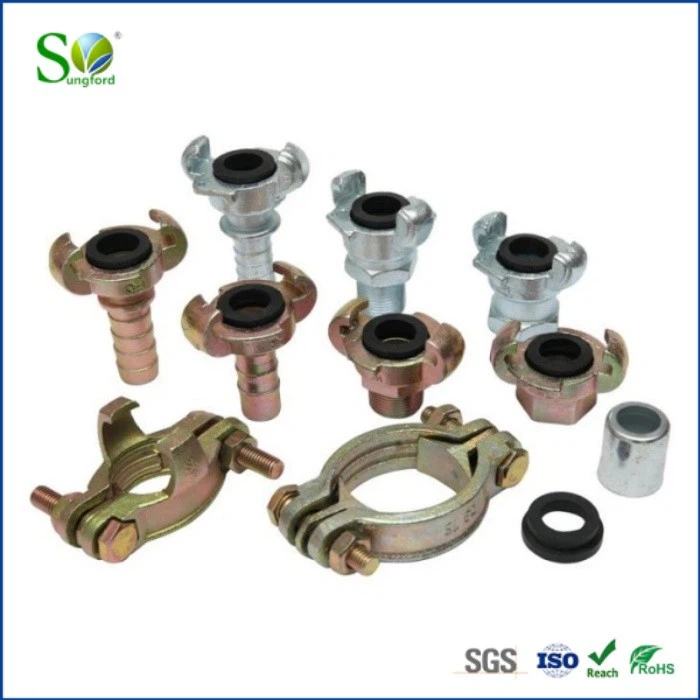
Straight hose couplings are great for applications where you need a direct, unobstructed flow of fluid. For example, in a water - supply system for a building, a straight coupling can be used to connect long sections of pipes in a straight line. They're also commonly used in industrial settings where large - volume fluid transfer is required, like in oil refineries or chemical plants.
However, straight hose couplings do have their limitations. They're not very flexible when it comes to routing hoses around obstacles. If you need to change the direction of the hose, you'll have to use additional fittings, which can add to the cost and complexity of the system. Also, in some cases, the straight design can make it difficult to access the coupling for maintenance or replacement.
Angled Hose Couplings
Now, let's move on to angled hose couplings. These couplings have a bend in them, usually at a 45 - degree or 90 - degree angle. This bend allows you to change the direction of the hose without having to use multiple straight couplings and additional fittings.
The main advantage of angled hose couplings is their flexibility. They're perfect for applications where you need to route hoses around corners, obstacles, or through tight spaces. For instance, in a car engine, where space is limited, angled couplings are used to connect various hoses, like the coolant hoses or the fuel lines. They can also be used in plumbing systems in small apartments or houses, where hoses need to be routed around fixtures and walls.
Another benefit of angled hose couplings is that they can reduce stress on the hoses. When a hose is forced to bend at a sharp angle, it can cause kinking, which restricts the flow of fluid and can even damage the hose over time. Angled couplings provide a smooth, pre - bent path for the hose, which helps to prevent kinking and extends the life of the hose.
But, just like straight couplings, angled hose couplings also have their drawbacks. They're more complex to manufacture than straight couplings, which means they're usually more expensive. Also, since they have a non - linear design, they require more precise alignment during installation. If the coupling isn't installed correctly, it can lead to leaks or a reduction in the flow rate.
Material and Compatibility
Both straight and angled hose couplings can be made from a variety of materials, including metal, plastic, and rubber. The choice of material depends on the application and the type of fluid being transferred.
Metal couplings, such as those made from stainless steel or brass, are strong and durable. They're resistant to corrosion and can withstand high pressures and temperatures. They're commonly used in industrial applications where reliability is crucial, like in hydraulic systems or chemical processing plants.
Plastic couplings are lightweight and inexpensive. They're also resistant to chemicals and are often used in applications where corrosion is a concern, like in water - treatment plants or in the food and beverage industry. However, plastic couplings may not be as strong as metal couplings and may not be suitable for high - pressure applications.
Rubber couplings are flexible and can absorb vibrations. They're often used in applications where there is movement or vibration, like in automotive engines or in marine applications. But rubber couplings may not be as durable as metal or plastic couplings and may need to be replaced more frequently.
When choosing a hose coupling, it's important to make sure that the material is compatible with the fluid being transferred. For example, if you're transferring a corrosive chemical, you'll need a coupling made from a material that is resistant to that chemical.
Installation and Maintenance
Installing both straight and angled hose couplings requires some basic tools and a bit of know - how. For both types, you'll need to make sure that the hoses are clean and free of debris before installing them on the coupling. You may also need to use hose clamps to secure the hoses to the coupling. You can find a variety of Hose Clampls to suit your needs.
To install a straight hose coupling, simply slide the hoses onto the coupling until they're fully seated. Then, tighten the hose clamps to prevent leaks. For an angled hose coupling, you'll need to make sure that the angle of the coupling matches the direction you want the hose to go. You may need to use a wrench or pliers to tighten the clamps, depending on the size of the coupling.
Maintenance of hose couplings is also important to ensure their proper functioning. Regularly check the couplings for signs of wear, such as cracks or leaks. If you notice any damage, replace the coupling immediately. You should also clean the couplings periodically to remove any dirt or debris that could cause blockages or damage to the hoses.
Choosing the Right Coupling for Your Application
So, how do you decide whether to use a straight or an angled hose coupling? Well, it all depends on your specific application. If you need a simple, cost - effective solution for a direct fluid transfer, a straight hose coupling is probably the way to go. But if you need to route hoses around obstacles or through tight spaces, an angled hose coupling will be more suitable.
Consider the flow rate, pressure, and type of fluid you'll be transferring. If you need a high - volume, unobstructed flow, a straight coupling might be better. But if you're dealing with a lower - volume flow and need flexibility, an angled coupling could be the answer.
Also, think about the long - term maintenance and cost of the system. While angled couplings may be more expensive upfront, they can save you money in the long run by reducing the need for additional fittings and preventing hose damage.
Conclusion
In conclusion, both straight and angled hose couplings have their own unique advantages and disadvantages. As a supplier, I've seen firsthand how important it is to choose the right coupling for the job. Whether you're a DIY enthusiast working on a home project or an engineer designing a complex industrial system, understanding the differences between these two types of couplings is crucial.
If you're still not sure which coupling is right for your application, don't hesitate to reach out. We're here to help you make the best choice for your needs. Whether you need a straight coupling for a simple water - supply system or an angled coupling for a tight - space automotive application, we've got you covered. Contact us to start a procurement discussion and find the perfect hose coupling for your project.
References
- "Handbook of Fluid Power Technology" by Heinz P. Bloch
- "Industrial Pipe Fittings Handbook" by Robert G. Budinski