

What is the air leakage rate of pu air ducting hose?
As a supplier of PU air ducting hoses, I often get asked about the air leakage rate of these hoses. It's a crucial parameter that affects the efficiency and performance of any ventilation or air - handling system. In this blog, I'll delve into what the air leakage rate of PU air ducting hoses is, the factors influencing it, and how we ensure our products meet high - quality standards.
Understanding the Air Leakage Rate
The air leakage rate of a PU air ducting hose refers to the amount of air that escapes from the hose during its normal operation. It is usually expressed as a percentage of the total air volume flowing through the hose. For example, if a hose has an air leakage rate of 5%, it means that 5% of the air that is supposed to be transported through the hose actually leaks out.
This rate is significant because it directly impacts the efficiency of the ventilation system. A high air leakage rate can lead to increased energy consumption as the system has to work harder to maintain the desired air volume. It can also result in uneven air distribution, which may affect the comfort and air quality in the environment where the system is installed.
Factors Affecting the Air Leakage Rate of PU Air Ducting Hoses
1. Material Quality
The quality of the polyurethane (PU) material used in the hose is a fundamental factor. High - quality PU materials have better integrity and fewer microscopic pores or defects. Our PU Air Ducting Hose is made from premium - grade PU, which has been carefully selected to minimize air leakage. The material's elasticity and strength also play a role. A more elastic and strong material can better withstand pressure changes without developing cracks or gaps that could lead to air leakage.

2. Manufacturing Process
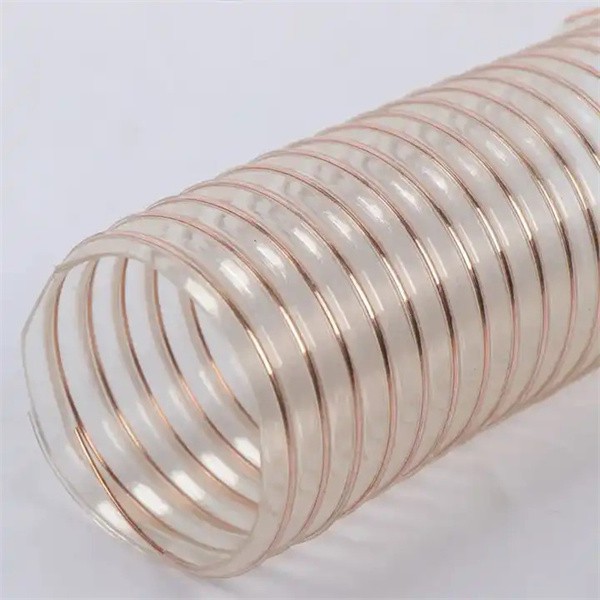
The way the hose is manufactured can greatly influence the air leakage rate. Precise extrusion and molding processes are essential. During manufacturing, any irregularities in the hose's wall thickness or seams can cause air to leak. Our production facilities use state - of - the - art equipment and strict quality control measures to ensure that each PU Steel Wire Duct Hose is produced with consistent wall thickness and well - sealed seams. For example, the steel wire reinforcement in our hoses is evenly embedded, which not only provides structural support but also helps prevent air from seeping out through the sides.
3. Fittings and Connections
The quality of the fittings and connections used with the hose is another important factor. Poorly designed or installed fittings can create gaps where air can escape. We offer a range of high - quality fittings that are specifically designed to work seamlessly with our PU air ducting hoses. These fittings are made from durable materials and are engineered to provide a tight seal, reducing the air leakage rate at the connection points.
4. Operating Conditions
The conditions under which the hose operates can also affect the air leakage rate. High - pressure applications may cause the hose to expand slightly, and if the material is not strong enough, it can lead to increased leakage. Temperature and humidity can also have an impact. Extreme temperatures can cause the PU material to become brittle or soft, potentially increasing the risk of air leakage. Our hoses are designed to perform well under a wide range of operating conditions, but it's still important to choose the right hose for the specific application.
Measuring the Air Leakage Rate
There are several methods to measure the air leakage rate of a PU air ducting hose. One common method is the pressure - decay test. In this test, the hose is sealed at both ends and pressurized to a specific level. Then, the pressure inside the hose is monitored over a period of time. If the pressure drops, it indicates that air is leaking out of the hose. The rate of pressure decay can be used to calculate the air leakage rate.
Another method is the flow - measurement test. In this test, the air flow rate into the hose is measured, and then the air flow rate at the outlet of the hose is measured. The difference between the two flow rates represents the amount of air that has leaked out of the hose.
Our Commitment to Low Air Leakage Rates
As a supplier, we are committed to providing PU air ducting hoses with low air leakage rates. We conduct rigorous testing on all our products to ensure that they meet or exceed industry standards. Our research and development team is constantly working on improving the material and manufacturing processes to further reduce the air leakage rate.
We also offer technical support to our customers. We can help them choose the right hose for their specific application, taking into account factors such as air volume, pressure, and operating conditions. By doing so, we can ensure that our customers get the most efficient and reliable ventilation solutions.
Why Choose Our PU Air Ducting Hoses?
- High - Quality Materials: Our hoses are made from premium - grade PU materials that are resistant to wear, tear, and chemicals.
- Advanced Manufacturing: We use the latest manufacturing techniques to ensure consistent quality and low air leakage rates.
- Comprehensive Testing: Every hose undergoes strict quality control and testing to guarantee its performance.
- Customization Options: We can customize our hoses to meet the specific requirements of our customers, including size, length, and fitting options.
If you're in the market for high - quality PU air ducting hoses with low air leakage rates, we'd love to hear from you. Whether you're working on a small - scale ventilation project or a large - scale industrial application, our products can provide the solution you need. Contact us to discuss your requirements and start a procurement negotiation. We're confident that our products will meet your expectations and help you achieve an efficient and reliable ventilation system.
References
- ASHRAE Handbook - HVAC Systems and Equipment. American Society of Heating, Refrigerating and Air - Conditioning Engineers.
- ISO 16842:2017. Rubber and plastics hoses and hose assemblies - Vocabulary. International Organization for Standardization.