

In the realm of TIG (Tungsten Inert Gas) welding, the performance of a welding hose is a critical factor that can significantly influence the quality and efficiency of the welding process. As a dedicated welding hose supplier, I've witnessed firsthand how the right hose can make a substantial difference in a TIG welding setup. In this blog, I'll delve into the various aspects of how a welding hose performs in a TIG welding environment.
1. Gas Delivery Precision
One of the primary functions of a welding hose in a TIG welding setup is to deliver the shielding gas accurately to the welding area. TIG welding relies on a shielding gas, typically argon or a mixture of argon and other gases, to protect the weld pool from atmospheric contamination. A high - quality welding hose ensures a consistent and precise flow of gas.
The inner lining of the hose plays a crucial role in gas delivery. A smooth and non - porous inner lining minimizes gas friction and prevents gas leakage. This is essential because any disruption in the gas flow can lead to weld defects such as porosity, oxidation, and poor bead appearance. For example, if the gas flow is inconsistent, the shielding gas may not fully cover the weld pool, allowing oxygen and nitrogen from the air to react with the molten metal.
Our Oxygen Acetylene Welding Hose is designed with a high - quality inner lining that provides excellent gas - tightness. It maintains a stable gas flow rate, which is vital for achieving clean and high - quality TIG welds.
2. Flexibility and Maneuverability
TIG welding often requires the welder to access hard - to - reach areas and work in various positions. Therefore, the flexibility of the welding hose is of utmost importance. A flexible hose allows the welder to move the torch freely without being restricted by the hose's stiffness.
A flexible welding hose can also reduce operator fatigue. When the hose can bend and twist easily, the welder doesn't have to exert excessive force to position the torch correctly. This is especially beneficial during long - duration welding jobs.
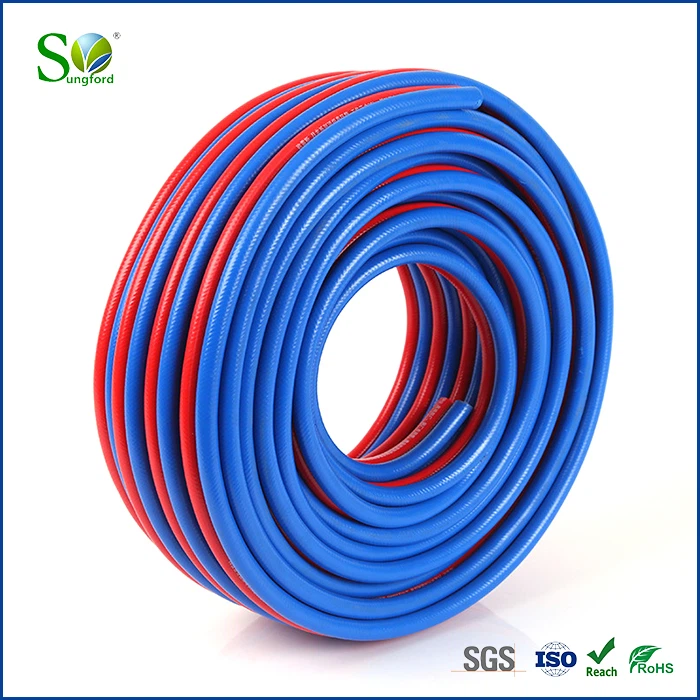
Our PVC Twin Welding Hose is known for its exceptional flexibility. It can be bent and coiled without kinking, ensuring that the welder can work comfortably and efficiently in any welding position.
3. Durability and Resistance
In a TIG welding environment, the welding hose is exposed to various hazards such as heat, abrasion, and chemical exposure. A durable hose is essential to withstand these harsh conditions and ensure long - term performance.
Heat resistance is crucial because the welding process generates a significant amount of heat. A hose that can resist high temperatures will not degrade or melt, which could lead to gas leakage or even a safety hazard. Abrasion resistance is also important as the hose may rub against sharp edges or other objects during the welding process.
Our welding hoses are made from high - quality materials that offer excellent heat and abrasion resistance. They are also resistant to chemicals commonly used in the welding industry, ensuring that they can maintain their integrity even in the most challenging environments.
4. Pressure Rating
The pressure rating of a welding hose is another critical factor in a TIG welding setup. The shielding gas is typically stored in high - pressure cylinders, and the hose must be able to handle the pressure without bursting or leaking.

A hose with a proper pressure rating ensures the safe and efficient delivery of gas. If the pressure rating is too low, the hose may fail under the high - pressure conditions, leading to gas leakage and potential safety risks. On the other hand, a hose with an overly high pressure rating may be unnecessarily thick and heavy, reducing its flexibility and maneuverability.
Our welding hoses are carefully designed with appropriate pressure ratings to meet the requirements of TIG welding. They can handle the pressure from the gas cylinders while maintaining a safe and stable gas flow.
5. Compatibility
In a TIG welding setup, the welding hose must be compatible with other components such as the gas regulator, torch, and gas cylinder. Compatibility ensures a proper connection and prevents gas leakage.
The fittings on the hose must match the fittings on the other components. A poor - fitting connection can lead to gas leaks, which not only waste gas but also pose a safety hazard. Our welding hoses come with a variety of fittings that are designed to be compatible with standard TIG welding equipment.
6. Impact on Weld Quality
The performance of the welding hose directly impacts the quality of the TIG welds. A well - performing hose ensures a stable gas flow, which is essential for protecting the weld pool from contamination. This results in welds with better mechanical properties, such as higher strength and ductility.
A consistent gas flow also helps in achieving a uniform bead appearance. The weld bead will be smooth and free of defects, which is important for both the aesthetic and functional aspects of the weld.
7. Maintenance and Longevity
Proper maintenance of the welding hose can extend its lifespan and ensure its continued performance. Regular inspection for signs of wear, such as cracks, abrasions, or leaks, is essential. If any damage is detected, the hose should be repaired or replaced immediately.
Storing the hose properly when not in use can also prevent damage. Hoses should be coiled neatly and stored in a cool, dry place away from direct sunlight and heat sources.
As a welding hose supplier, we provide guidance on the proper maintenance of our hoses. Our hoses are designed to be low - maintenance, but following these simple steps can help ensure their long - term performance.
Contact for Purchase and Negotiation
If you're in the market for high - quality welding hoses for your TIG welding setup, we're here to help. Our team of experts can assist you in choosing the right hose based on your specific requirements. Whether you need a hose with high flexibility, excellent durability, or a specific pressure rating, we have the solution for you. Contact us today to start the procurement negotiation process and take your TIG welding to the next level.
References
- AWS Welding Handbook, Volume 1: Welding Science and Technology. American Welding Society.
- Welding Metallurgy by John C. Lippold and David J. Kotecki.